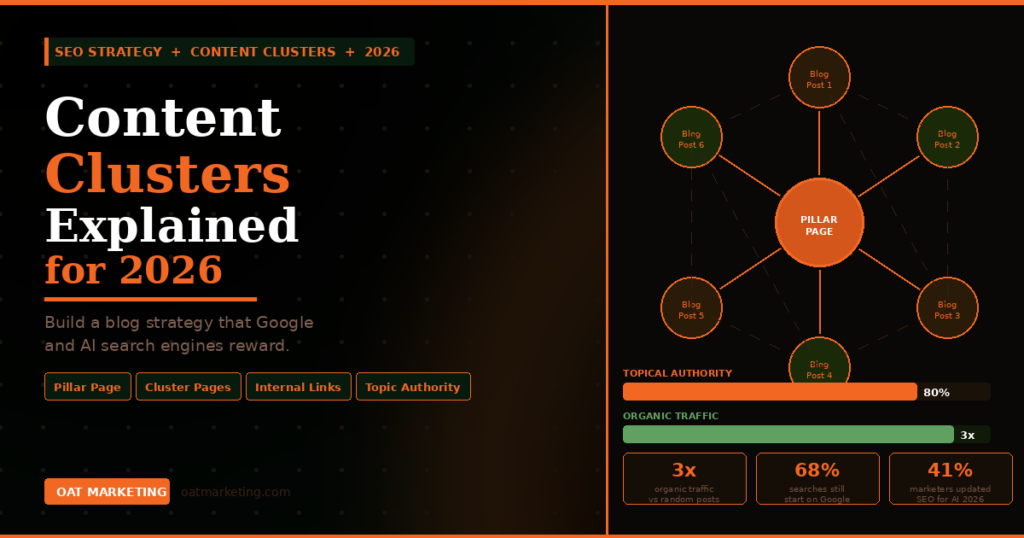
Writing random blog posts and hoping they rank is a strategy that stopped working in 2024. In 2026, Google and AI search engines reward businesses that demonstrate deep, connected expertise across a topic. That is what a content cluster is. This guide explains the concept clearly and shows you how to build one from scratch for your business.
A content cluster is a group of related pages on your website that all connect to a central pillar page. The pillar page covers a broad topic at a high level. The cluster pages each go deep on a specific subtopic. When they all link to each other, they signal to Google that your site has genuine authority on the whole topic, not just one piece of it.
Why Random Blog Posts No Longer Work
The old approach to blogging was simple: find a keyword with decent search volume, write an article targeting it, and wait for it to rank. This worked when Google was a keyword-matching machine. Google is no longer a keyword-matching machine. It is a topic authority evaluation system.
When Google evaluates your site today, it is not just asking "does this page have the right keywords?" It is asking "does this entire website demonstrate real expertise in this subject area?" A site with 40 loosely related blog posts on random marketing topics looks fragmented and low-authority. A site with a tight cluster of 8 deeply connected pages on local restaurant marketing looks authoritative. The cluster wins every time.
What changed in 2026: AI Overviews now pull from multiple pages on a single site when constructing answers. If you have a well-built content cluster, Google may cite your site multiple times in one AI Overview response, dramatically increasing your brand visibility even in zero-click scenarios.
How a Content Cluster Is Structured
| Page Type | Purpose | Length | Example |
|---|---|---|---|
| Pillar Page | Covers the broad topic at high level, links to all cluster pages | 2,000 to 4,000 words | "Complete Guide to Restaurant Marketing" |
| Cluster Page | Goes deep on one specific subtopic, links back to pillar | 800 to 1,500 words | "How to Get More Google Reviews for Your Restaurant" |
| Cluster Page | Another specific subtopic | 800 to 1,500 words | "Restaurant Instagram Strategy: What to Post in 2026" |
| Cluster Page | Another specific subtopic | 800 to 1,500 words | "Google Ads for Restaurants: Step-by-Step Setup" |
| Supporting Content | FAQ pages, glossary entries, case studies that support the cluster | 400 to 800 words | "What Is a Google Business Profile and Do I Need One?" |
How to Build a Content Cluster: Step by Step
Choose your pillar topic
Pick the single most important topic for your business. For a digital marketing agency, this might be "local business marketing." For a restaurant, it might be "dining in Pattaya." For a clinic, it might be "dental care in Bangkok." This should be the topic you most want to be seen as an expert in. It should be broad enough to support 6 to 10 subtopics.
Map all the subtopics
Brainstorm every specific question or subtopic that falls under your pillar topic. Think about what your customers actually ask before buying from you, what problems they are trying to solve, and what misconceptions they have. Each subtopic becomes one cluster page. Aim for a minimum of 6 subtopics to start.
Create the pillar page first
Write a comprehensive overview of the entire topic. The pillar page should answer the big question at a high level and link out to each cluster page for more detail. Use a clear heading structure, include a table of contents, and end with links to all your cluster articles. This page is the hub of your content wheel.
Build cluster pages one at a time
Write each cluster page to go deep on its specific subtopic. Answer the question completely. Include practical steps, examples, and data. At the end of each cluster page, link back to the pillar page and to 2 or 3 related cluster pages. This internal linking structure is what tells Google your content is connected and authoritative.
Update regularly and track rankings
Content clusters are not a one-time project. Add new cluster pages as new subtopics emerge. Update existing pages when information changes. Monitor rankings for each page and identify which are gaining traction so you can create more content in that direction. A living, growing cluster compounds in authority over time.
Want a content cluster built for your business?
OAT Marketing plans, writes, and publishes complete content clusters that build your authority and drive organic traffic. No guesswork, no random posts.
Content Cluster Examples by Business Type
For a Restaurant
- Pillar: The Complete Guide to Dining at [Restaurant Name] in Pattaya
- Cluster: Our Menu Explained: Every Dish and What Makes It Special
- Cluster: Private Dining at [Restaurant Name]: How to Book for Groups
- Cluster: Best Dishes for First-Time Visitors
- Cluster: [Restaurant Name] vs Other Japanese Restaurants in Pattaya
- Cluster: What Our Customers Say: Real Reviews and Highlights
For a Clinic
- Pillar: Dental Care in Bangkok: Everything You Need to Know
- Cluster: How Much Does a Dental Cleaning Cost in Bangkok?
- Cluster: Teeth Whitening vs Veneers: Which Is Right for You?
- Cluster: What to Expect on Your First Visit to Our Clinic
- Cluster: Emergency Dental Treatment in Bangkok: What to Do
- Cluster: How to Choose the Right Dentist in Bangkok
The Connection Between Content Clusters and AI Search
When AI systems like Google's AI Overviews or ChatGPT search for information to include in their answers, they favour sources that demonstrate broad, connected expertise rather than one-off articles. A well-built content cluster signals exactly that. Your site becomes the trusted reference for its topic rather than a single-page contributor.
This is why content clusters have moved from a best practice to a necessity in 2026. They are the structural foundation that allows AI systems to trust and cite your brand repeatedly across multiple queries in your category.
- Identify your single most important pillar topic this week
- Brainstorm at least 8 specific subtopics that fall under it
- Check if any of these subtopics already have pages on your site that could be connected
- Write your pillar page first and publish it before building cluster pages
- Build one cluster page per week for 8 weeks and link everything together
- Add FAQ Schema markup to every page in the cluster
- Set a reminder to update each page every 6 months
Content Strategy That Builds Real Authority
From content cluster planning to writing, publishing, and internal linking, OAT Marketing handles the full content ecosystem for your business.
Stop Writing Random Blog Posts. Start Building Authority.
OAT Marketing builds content clusters that make your business the trusted source in your category. Let us build yours.
Book a Free Strategy Call