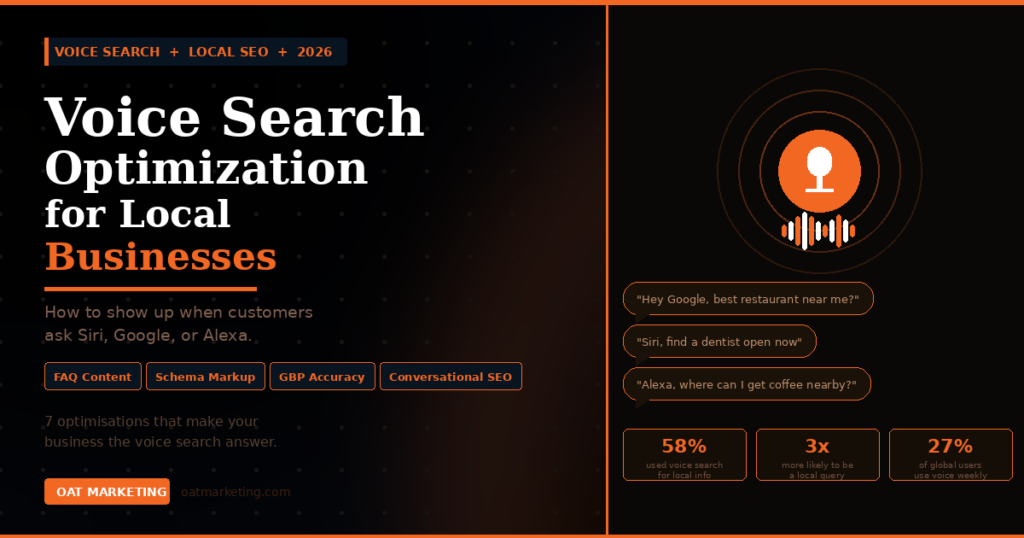
When someone asks Siri "where should I eat tonight near me?" or tells Google Assistant "find me a dentist open on Saturday", your business either appears or it does not. Voice search now handles billions of local queries every month and most businesses have done nothing to optimise for it. This guide shows you exactly how to show up when customers ask instead of type.
Voice search is not a future trend. It is already the dominant way millions of people find local businesses, check opening hours, get directions, and make booking decisions. The difference between voice search and text search is fundamental: people type keywords but they speak full questions. "Italian restaurant Pattaya" becomes "Hey Google, what is the best Italian restaurant near me open for dinner tonight?" Your entire content strategy needs to reflect this difference.
How Voice Search Results Are Chosen
When someone asks a voice assistant a question, the assistant delivers one answer, not a page of ten links. That single answer comes from one of three sources: a featured snippet on a website, a Google Business Profile, or an AI Overview. This winner-take-all format makes voice search optimisation both more competitive and more valuable than traditional search. Being the one result that gets read aloud is the digital equivalent of a personal recommendation to every person who asks that question.
Why local businesses have an advantage: Voice search queries are overwhelmingly local and immediate. "Near me", "open now", "today", and "this weekend" appear in voice searches at dramatically higher rates than text searches. Businesses that optimise their local presence correctly are perfectly positioned to capture this high-intent traffic.
The 7 Optimisations That Make Your Business Voice-Search Ready
Write content in natural, conversational language
Read your website content aloud. If it sounds like a brochure rather than a conversation, rewrite it. Voice search algorithms favour content that mirrors how people actually speak. Replace "we provide exceptional culinary experiences" with "we serve some of the best Japanese food in Pattaya." Write the way your best customers talk about you.
Build a comprehensive FAQ section targeting question keywords
Voice searches are almost always questions. "What time does X open?" "How much does X cost?" "Is X good for families?" "Does X have parking?" Create a dedicated FAQ page on your website and answer every question your customers ask, in the exact phrasing they use. Each answer should be 2 to 4 clear sentences. This format is what voice assistants extract and read aloud as their answer.
Keep your Google Business Profile perfectly up to date
The majority of voice search answers for local businesses come directly from Google Business Profiles. Your hours, location, phone number, services, and category must be accurate at all times. If someone asks "is [your business] open right now?" and your GBP says you close at 10pm but you actually close at 11pm, the voice assistant gives wrong information and customers do not show up.
Implement LocalBusiness and FAQ Schema markup
Schema markup tells search engines exactly what your content means, dramatically increasing the chance that your answers are used in voice search responses. LocalBusiness Schema provides structured data about your business name, address, hours, and contact details. FAQ Schema marks up your question-and-answer content so voice assistants can extract it cleanly.
Target long-tail, question-based keywords in your content
Instead of optimising only for "Japanese restaurant Pattaya", also optimise for "best Japanese restaurant for date night in Pattaya", "Japanese restaurant in Pattaya with private rooms", and "where to eat sushi near Walking Street." These longer, specific phrases match exactly how voice search queries are structured and face far less competition than short keyword phrases.
Earn mentions on trusted local platforms
Voice assistants cross-reference multiple sources when building their answers. The more your business is mentioned on trusted platforms including Google, TripAdvisor, Yelp, food blogs, and local news sites, the more confident the assistant is that your business is a credible result for relevant queries. Local citation building is voice search optimisation.
Optimise your website for mobile speed
Almost all voice search happens on mobile devices. If your website loads slowly on mobile, voice assistants are less likely to surface it as a result. Use Google's PageSpeed Insights to test your mobile load time and fix the issues identified. A 1-second improvement in mobile load time can increase conversions by up to 27%.
Is your business showing up in voice search results?
OAT Marketing optimises your complete local presence for voice search, AI assistants, and traditional search. Free audit to show you where you stand.
The Questions Your Business Must Answer Online Right Now
Think about the 10 most common questions you are asked by customers before they visit or make a booking. Every single one of those questions should have a clear, direct answer somewhere on your website, in your GBP, or on your social media. Here are the most common voice search questions for local businesses, with examples:
| Voice Search Query Type | Example Query | Where the Answer Should Live |
|---|---|---|
| Hours | "What time does X close on Sunday?" | Google Business Profile + website footer |
| Location | "Where is X located?" | Google Business Profile + website contact page |
| Price | "How much does X cost at [business]?" | Website FAQ + GBP services section |
| Availability | "Does X take walk-ins or do I need to book?" | Website FAQ + GBP description |
| Category | "Best [type] near me open now" | GBP category + reviews + proximity |
| Comparison | "Is [business] good for families?" | Website FAQ + Google reviews content |
- GBP hours are accurate including special hours for holidays and events
- GBP phone number, address, and website link are all correct and up to date
- Website has a dedicated FAQ page with at least 10 questions answered in conversational language
- FAQ Schema markup is implemented on your FAQ page
- LocalBusiness Schema is implemented on your homepage
- Website loads in under 3 seconds on mobile
- Business is listed accurately on TripAdvisor, Yelp, and at least 3 industry-specific directories
Get Found When Customers Ask Their Phones
OAT Marketing optimises your entire online presence for voice search, AI assistants, and local search. We handle the technical details so you appear when it matters most.
Be the Answer When Customers Ask.
OAT Marketing makes your business the result that voice assistants recommend. Book a free strategy session to find out where you stand.
Book a Free Call